Low weight
A cellular structure reduces the amount of solid polymer in a component.
Balance the weight target against support, stiffness and handling loads.

MATERIALS / EPP
Expanded polypropylene (EPP) is a lightweight, closed-cell bead foam moulded into protective packaging, insulation and technical components. Its performance depends on grade, density and part design.
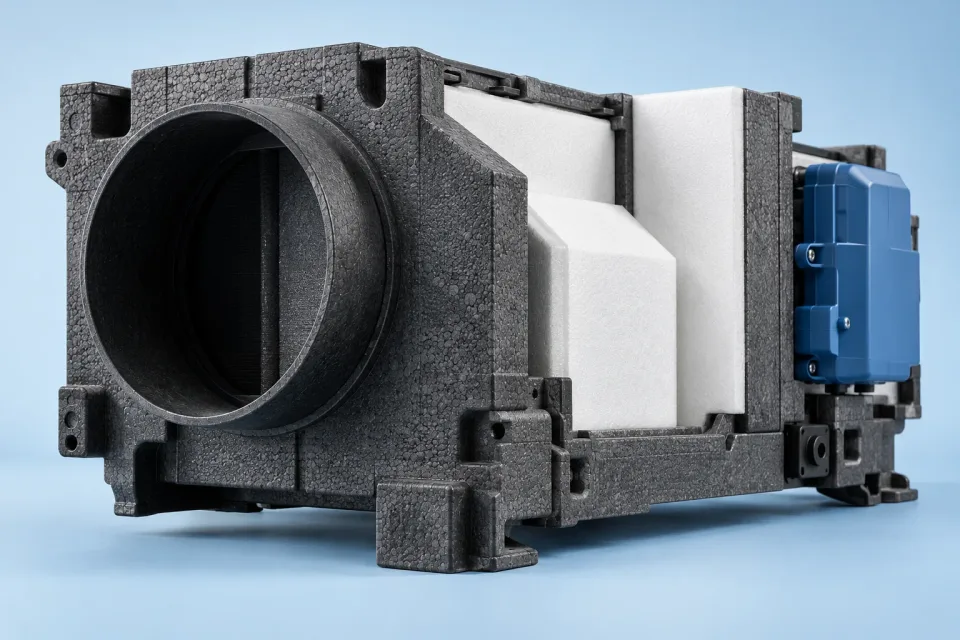
THE MATERIAL, EXPLAINED
Expanded polypropylene, or EPP, is a thermoplastic bead foam with a predominantly closed-cell structure.
Air-filled beads form components combining low weight, cushioning and insulation. Grade, density and geometry determine performance.
Explore our four industriesThin polypropylene walls surround the cells inside each expanded bead.
Simplified material illustrationWHY EPP?
Choose the grade, density and geometry around the job the finished component needs to do.
A cellular structure reduces the amount of solid polymer in a component.
Balance the weight target against support, stiffness and handling loads.
EPP can absorb impact energy and recover after deformation.
Repeated-impact performance depends on the grade, geometry and severity of loading.
The foam structure helps slow heat transfer through a part.
Evaluate thickness, joints and operating temperatures in the complete assembly.
Closed cells limit water uptake within the material.
Seams, openings and cleaning conditions still need attention in a finished product.
EPP can contribute to quieter technical assemblies.
Request measurements for the actual frequencies, mountings and material grade; acoustic functions differ.
Cavities, ribs and interfaces can be designed into a foam component.
Discuss bead access, wall thickness, draft, vent locations and demoulding before fixing the drawing.
FROM BEAD TO COMPONENT
Select expanded beads and fill the mould cavity. Pressure filling introduces beads into a closed tool.
Steam heats the packed beads so their surfaces bond into the required foam shape.
Cool and stabilise the part, then open the mould and eject it with support.
Apply any specified conditioning, then check dimensions, density, appearance and fit.
FOUR INDUSTRIES. MANY USES.
Lightweight forms for activity and play.
Sports accessories · Moulded toy components · Protective equipment inserts
Define users, contact, attachments and complete-product testing.
Protection shaped around the handling cycle.
Returnable trays · Protective inserts · Insulated containers
Map payload, stacking, cleaning and return journeys.
Combine insulation with component integration.
Insulating housings · Equipment supports · Thermal covers
Evaluate heat, condensation, noise and service access.
Lightweight components within larger vehicle assemblies.
Energy absorbers · Tool organisers · Component packaging
Validate loads, temperature, attachment and assembly behaviour.
A BETTER DESIGN BRIEF
Bring these details into the conversation before selecting a material grade or committing to tooling.
Share dimensions, contact surfaces, clearances, attachment points and inspection datums.
State payload, drop conditions, compression, repeated handling and acceptable deformation.
Describe temperatures, exposure duration, moisture, vibration and cleaning chemicals.
Specify the finished density and tolerance; request the matching grade data.
Identify food contact, fire performance, electrical protection or UV requirements early.
Agree wall transitions, draft, visible vent marks, colour and surface expectations.
Set tests, conditioning, dimensional tolerances and pass criteria before approving production.
Share quantities, planned reuse, cleaning, collection and the intended recycling route.
GOOD QUESTIONS. CLEAR ANSWERS.
It uses polypropylene in an expanded cellular form. Solid PP mouldings and EPP foam components therefore need different geometry and performance specifications.
Start with the required load response and geometry. Distinguish loose-bead bulk density from finished moulded density; ask for relevant curves and tolerances.
Resilience supports repeated use, but damage and permanent deformation remain possible. Agree realistic impact conditions and inspection or replacement criteria.
Low material uptake does not establish a watertight container. Validate closures, joints and drainage against the intended exposure.
No blanket fire rating applies. Flame-retardant grades exist; request test evidence for the chosen grade, density, thickness and intended component.
Some grades have food-contact approval. Request current documentation for the exact material and intended conditions; the finished article may require migration testing.
Use the selected grade data and validate exposure duration, load and assembly fit. A generic foam temperature claim is insufficient for equipment design.
Recycled content varies by grade. Recyclability also needs a collection route that accepts the finished part, including its inserts, labels and contamination.
Shrinkage and tolerances depend on grade, density, tooling, geometry and processing. Agree critical dimensions and measurement conditions with the moulder.
Test representative parts in the intended assembly. Agree load, fit and repeated-use checks, then add application-specific thermal, acoustic or qualification tests.
YOUR APPLICATION. YOUR REQUIREMENTS.
Share your drawing, working environment and expected loads. Use the selected grade documentation and representative-part tests to define the requirements for your project.
FROM YOUR APPLICATION TO A CLEARER SPECIFICATION
Share your drawing, dimensions or current packaging.
Start a practical conversation about the right format.